Zero conversion ad campaigns
When testing out new advertising channels, you’re likely to run at least one campaign that produces exactly zero conversions. Along the way, you might wonder: how quickly can I call it quits on a particular campaign before moving on to try another?
Rule of thumb
If your campaign has spent 3X your customer margin and has produced zero conversions, then you can be >95% confident that the campaign is unprofitable. Here, customer margin is defined as a customer’s lifetime revenue minus all non-advertising variable costs associated with servicing that customer.
It turns out that there is a direct relationship between spend on a campaign with zero conversions and confidence that the campaign is unprofitable:
- 95% confidence in unprofitability ⟷ 3X margin with 0 conversions
- 80% confidence in unprofitability ⟷ 1.6X margin with 0 conversions
- 50% confidence in unprofitability ⟷ 0.7X margin with 0 conversion
Mathematical backing
Suppose that we have built a website that sells widgets. A few variables that’ll be helpful:
- : lifetime revenue from a purchasing customer, less all non-advertising variable costs
- : probability that each visitor results in a new customer who buys a widget
- : the volume of visitors that we receive for the above-defined budget of W
Breaking even
We’ll assume that all visitors in a campaign are equally likely to buy a widget. With this assumption, our purchase count will follow the binomial distribution with mean , as will our revenue with mean .
Our campaign will be profitable if we earn more than dollars in customer margin by spending dollars on our campaign: . By solving for , we can see that the campaign will break even if and will be profitable if . In layman’s terms, this basically means that if we spend on a campaign, at least one of our visitors needs to convert.
Confidence after N visitors
How large does have to be for us to falsely conclude that the campaign is unprofitable less than 5% of the time?
Because purchase count is distributed binomially, we’d expect to see zero purchases with probability . Therefore, we will look for an such that . Before doing so, however, we’ll set such that the campaign is break even (i.e., ); we can do this because for any profitable campaign, and because we’ll soon choose an such that .
We’ll plan to purchase visitors as a multiple of our budget, meaning we’d like to set . It turns out that for all , is maximized with respect to as approaches infinity. To gain intuition for why that’s the case, check out a graph of where .
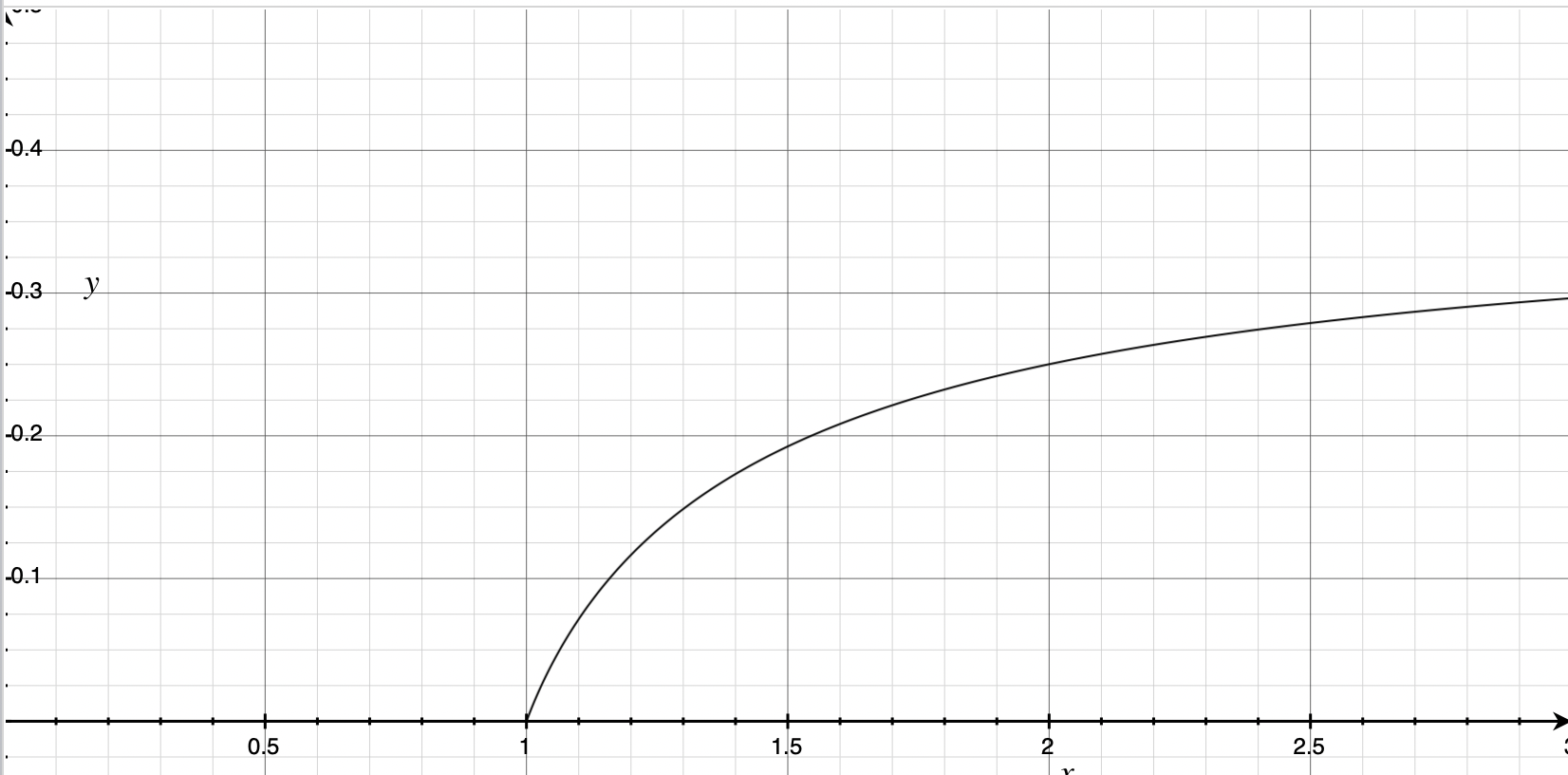
By taking , we can then solve for such that the inequality is true for all values of . After taking the limit, we see that . Solving for , we end up with ln(20) = 2.9957, which is how we got to our 3X rule of thumb. Generalizing this technique, we see that to achieve a given percent confidence that a campaign is in fact unprofitable after zero conversions, we need to spend multiplied by our customer’s lifetime margin.
Conclusions
This approach can give you a sense of how large a budget one should allocate to a test of a new ad platform, a new product, or a new landing page. Further, this approach works independent of whether you are buying mobile app installs, clicks, or impressions.
If your customers are typically worth $100 when they convert, then this rule of thumb tells you that the minimal rigorous test you can run on an advertising platform is in the ballpark of $200-$300. If you’d like to have the opportunity to run multiple campaigns (say, a dozen), you should expect to spend up to $3,600 (=$300*12) in exploratory budget.